

About David
Like many artists in their youth, Moneypenny started his painting career, creating pretty pictures with traditional themes and techniques. At age 17, a defining trip to the National Gallery of Canada in Ottawa profoundly changed his direction. He went to see the Expressionists, but soon came upon the linear and often abstracted works of Carl Andre, Sol LeWitt and Jasper Johns. Here was art as an idea instead of the impressionistic depiction of reality.
Moneypenny began his foray into contemporary art thanks to a full scholarship to the Hartford Art School, University of Hartford, Connecticut. The art school Foundation Program led him to believe that art and design can coexist in functional sculpture. He continually develops innovative processes and methods of crafting sculptures to communicate experiences and observations on social issues.


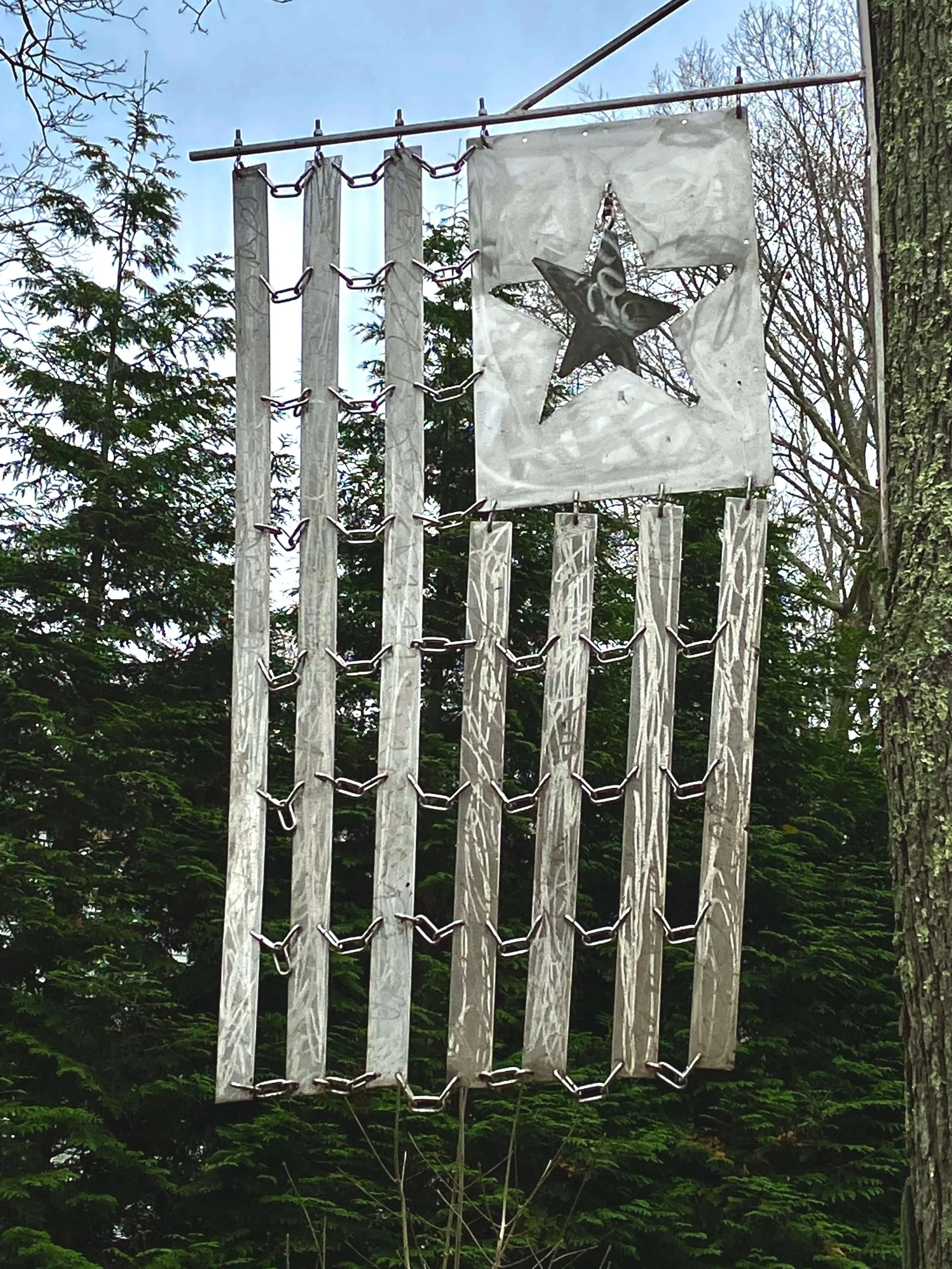
His unconventional use of materials defines David Moneypenny’s art. Moneypenny’s art is driven by salvaged and found raw materials because they have a history, a prior life, or an event that changed their form. He explores and invents new uses for old materials: flags made from salvaged steel; tree bark and latex caulk; or screening, paint and metal fragments; or exquisite furniture sculpture made from crumpled automobile metal combined with repurposed wood. Bringing the rawness of nature into the polished world, Moneypenny takes a hard look at our relationship with nature and what we do with discarded materials.
Robert Rauschenberg, and Jasper Johns, and the lyrics of Bob Dylan, influence Moneypenny’s art. They share an out-of-order perception of our world that creates tension. This tension appeals to Moneypenny, and his work often has an undercurrent of humor and edgy sarcastic wit. He believes the best part of an idea is the person who executes it and he uses the properties of the materials to deliver the idea.
Curriculum Vitae
-
1981 BFA University of Hartford, West Hartford, CT
1971 Rhode Island Governor’s School, Rhode Island School of Design, Providence, RI
-
2016 Private Viewing: For Your Eyes Only, Islip Art Museum, East Islip, NY
2015 Dwellings, Artspace New Haven CWOS, New Haven, CT
2009 Work It! Measure It! 120, Hartford Art School, University of Hartford, CT
2008 Size is Relative, Hartford Art School, University of Hartford, CT
2007 Alumni Smallworks Exhibition, Joseloff Gallery, Hartford Art School, University of Hartford, CT
2005 Christopher Horton Tribute Exhibition, Silpe Gallery, Hartford Art School, University of Hartford, CT
2005 Solo Exhibition, “Can You See It, Norm?” The New Space Gallery, Manchester Community College, CT
1980 Solo Exhibition, Real Art Ways, Hartford, CT
1978 Connecticut Invitational Anna Ball Pierce, Joseloff Gallery, Hartford Art School, University of Hartford, CT
1977 Solo Exhibition, Stars and Stripes Whenever, Joseloff Gallery, Hartford Art School, University of Hartford, CT
1975 Solo Exhibition, Stamp by Hand, Joseloff Gallery, Hartford Art School, University of Hartford, CT
1974 Solo Exhibition, Artist’s Guild & Gallery, Charlestown, RI
1973 Solo Exhibition, Artist’s Guild & Gallery, Charlestown, RI
-
2006 Sol Le Witt Project Visiting Artist, Elmer Theines Elementary School, 4th Grade, Marlborough, CT
-
1981 Graduation Award, Hartford Art School, University of Hartford, CT
1981 Honors Award, Hartford Art School, University of Hartford, CT
1977 Anna Ball Pierce Scholarship Award. Hartford Art School, University of Hartford, CT
1973 Full Scholarship, Hartford Art School, University of Hartford, CT
1971 Full Scholarship, Governor’s School, Rhode Island College, Providence, RI
1971 Best in Show, Westerly Art Festival, Westerly, RI
1970 Best in Show, Westerly Art Festival, Westerly, RI
1969 Best New Artist, Westerly Art Festival, Westerly, RI
-
Rosoff, Patricia. Review. “David Moneypenny.” Art New England December/January 2006: p. 25
Whitbeck, Doris. “Arts District Mushrooming in Shadow of Civic Center.” The Hartford Courant, Sunday, February 5, 1978: p.1G
-
Guilford, CT
Shelton, CT
San Diego, CA
Marlborough, MA
Los Angeles, CA
East Hampton, CT
-
The Furniture Society, Durham, North Carolina
Review by Patricia Rosoff
ART NEW ENGLAND
December/January 2006
DAVID MONEYPENNY
For David Moneypenny, meaning is about the generation of form; there is an insistent logic to his progressive build-up of it and a workmanlike delight in the processes of building a work of art. Still, within his spare, almost mathematical system there is an equally sensuous abandon when it comes to surface, and in his sculptures, light.
His artistic vocabulary is at once serious and playful, abstract and figurative, conceptual and physical—combining ciphers (circles, squares, and diagonals à la Leonardo da Vinci) with everyday materials and repeating motifs that he then buries and unburies in a variety of found and fabricated (but generally nonart) materials. He is as attentive to where you experience an object from (above, below, or at eye level) as he is to issues of scale (intimacy or monumentality).
Moneypennyʼs sense of process is a fascinating player in all of these images. He works from the center outward, burying and unburying the anchoring image of a five-pointed star in a drizzle of diaphanous surface decoration, creating a shimmering, pearly camouflage and building perforated forms in layers that freely march forward and back from the picture plane.
His approach is direct: He squeezes pigment directly from the tube, creating the welts of his cross-hatching; he never hides the underlying grid that supports the diagonal warp and woof of his drawing. He uses metallic paint (or graphite) to create a silvery sheen on his surfaces—denying the very surface he inscribes by rebounding the reflection of his mark-making right back at the viewer.
Ultimately, the end result is part da Vinci, part Sol LeWitt, part Jasper Johns, part Jackson Pollack—and none of the above. Visually intriguing, Moneypennyʼs work stands on a somewhat tentative ground between rationality and expressionism, restrained methodology and lavish sensuality
the Collections
Hard America

crashed
furniture

Assemblages/
Sculptures
